
Introduction
There was a time—not very long ago—when building a feature meant sitting down with a well-defined requirement, designing the system upfront, writing code line by line, and hoping that by the time you reached deployment, nothing fundamental had changed.
Today, that workflow feels almost… nostalgic.
We are entering a phase where development is no longer just about writing code. It’s about orchestrating intent. And tools like GitHub Copilot are not just assistants—they are reshaping how we think, design, and deliver software.
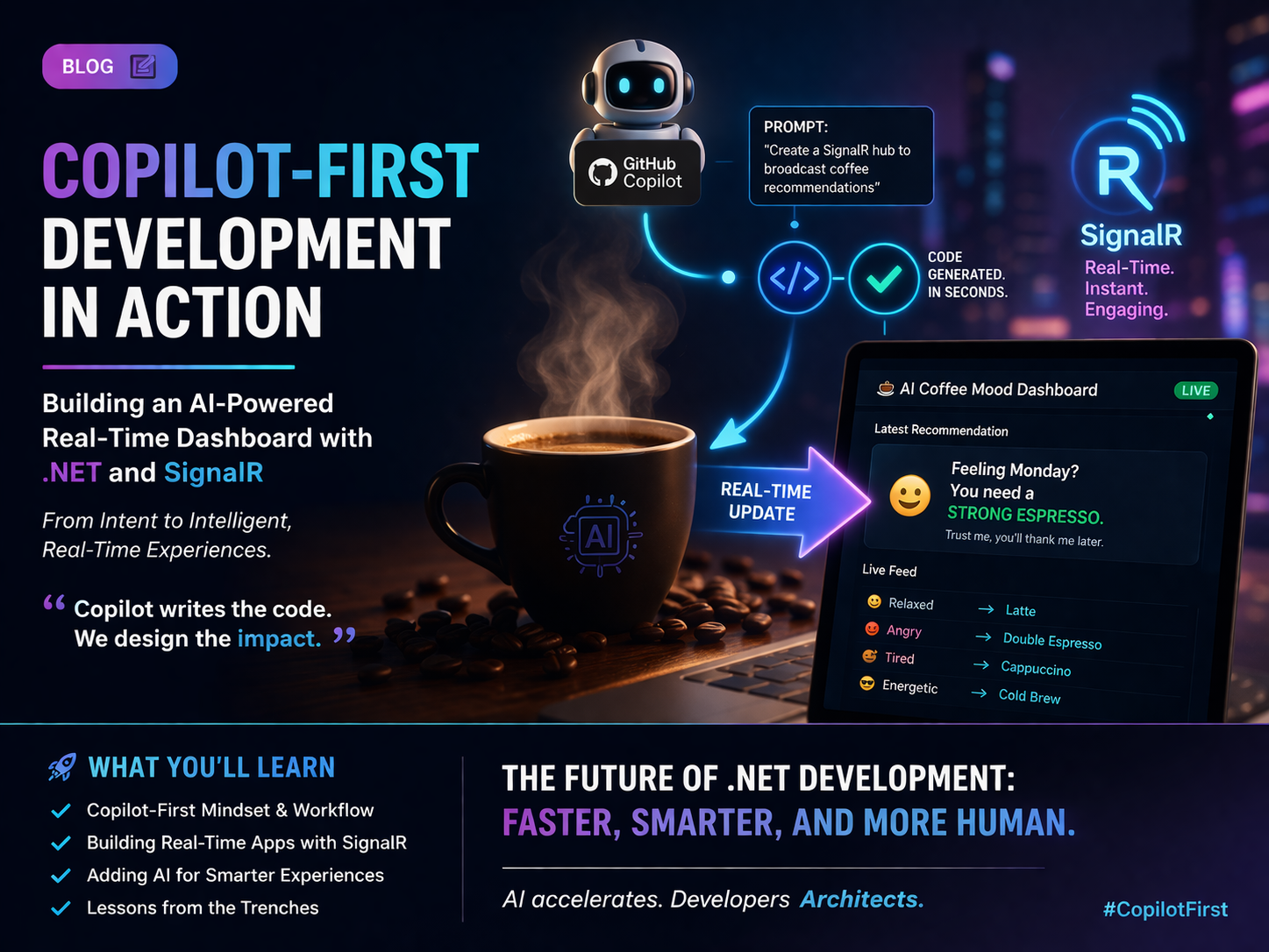
To understand this shift in a practical way, let’s walk through a deceptively simple system: a real-time, AI-powered dashboard built with .NET and SignalR. It may look like a playful “coffee recommendation engine,” but underneath, it represents the same patterns used in production systems—recommendation engines, fraud detection alerts, live monitoring dashboards, and intelligent notifications.
From CRUD to Experience-Driven Systems
Traditional enterprise applications were largely CRUD-based. You stored data, retrieved it, updated it, and displayed it. The user experience was reactive and often delayed.
Modern systems are different. They are:
- Event-driven
- Real-time
- Context-aware
- AI-augmented
Instead of asking, “What data should we store?”, we now ask:
“How should the system respond, in real time, to a user’s context?”
This shift is where technologies like SignalR and AI-assisted development converge beautifully.
The System: Simple on the Surface, Powerful in Pattern
In our example, a user sends their “state”:
- Mood
- Energy level
- Time of day
The system processes this input and:
- Generates a recommendation (AI-assisted logic)
- Broadcasts it instantly to all connected clients (SignalR)
- Updates a live dashboard in real time
At a glance, it’s trivial. But structurally, it mirrors real-world systems:
- A banking app pushing fraud alerts
- An e-commerce platform updating live recommendations
- A logistics system tracking fleet status in real time
The difference is not in complexity—it’s in responsiveness and intelligence.
The Role of Copilot: From Typing Code to Shaping Behavior
One of the most noticeable changes when building this system is how little time is spent on “writing code” in the traditional sense.
Instead, the workflow becomes:
- Describe intent
- Guide structure
- Validate output
- Refine behavior
For example, creating a SignalR hub is no longer a task that requires recalling syntax or searching documentation. A simple prompt describing the intent—“broadcast recommendations to connected clients”—is enough for Copilot to scaffold a working implementation.
This is not just about speed. It changes the developer’s role.
You are no longer the person typing every line. You are:
- Reviewing design decisions in real time
- Evaluating correctness and trade-offs
- Steering the system toward maintainability
Or put differently:
The bottleneck has moved from typing speed to thinking clarity.
Real-Time Communication: Where SignalR Changes the Game
In many enterprise systems, real-time capabilities are still treated as an afterthought—added later through polling or periodic refresh mechanisms.
SignalR flips that model.
With minimal setup, the backend can push updates directly to connected clients. In our case, when a new recommendation is generated, it is instantly broadcast to every dashboard connected to the system.
This pattern is incredibly powerful in production environments:
- Customer service dashboards updating ticket status live
- Trading platforms reflecting price changes instantly
- IoT systems streaming telemetry data in real time
What’s important here is not the technology itself, but the architectural mindset:
Systems should react to events, not wait to be queried.
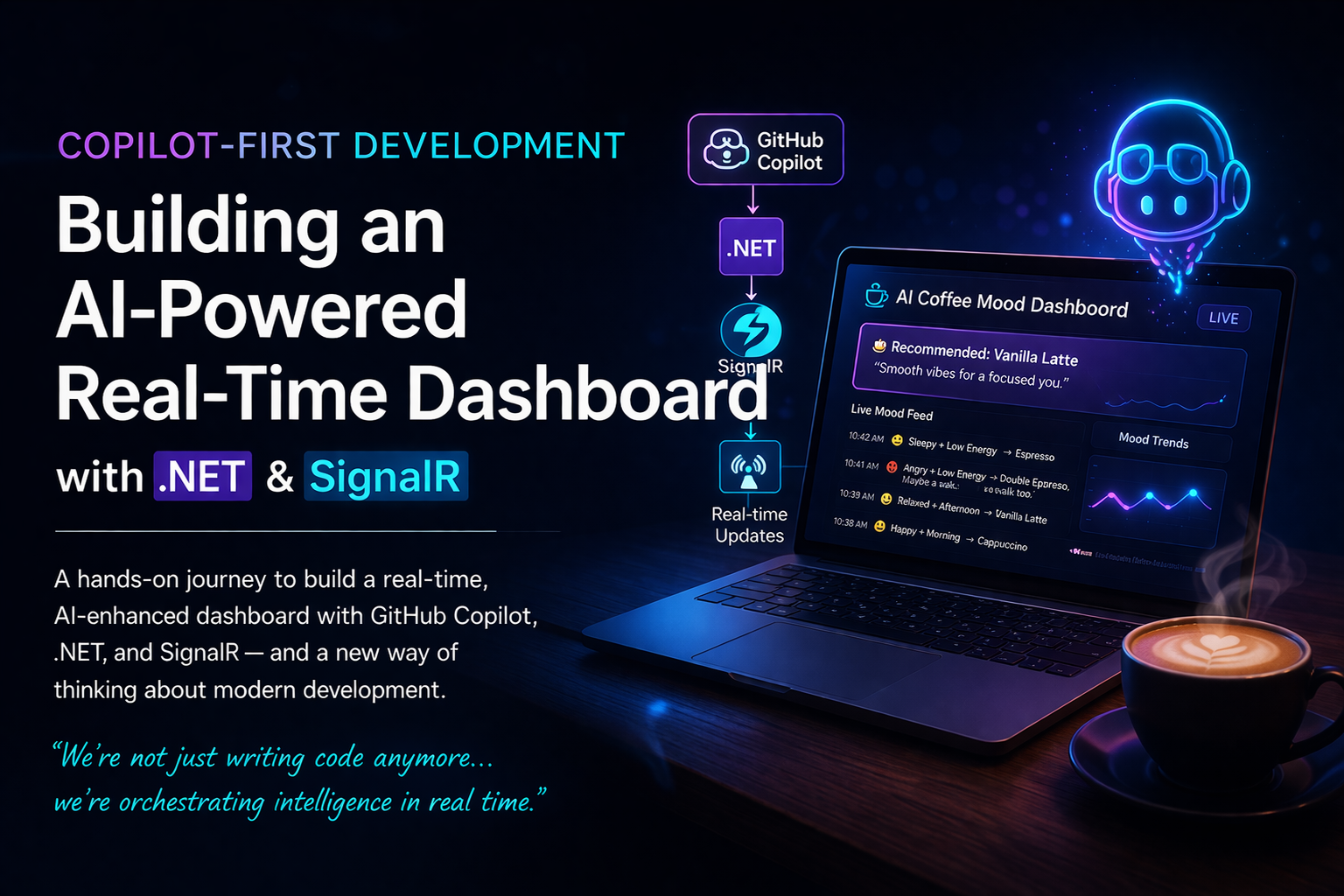
High Level Architecture Diagram
┌──────────────────────┐
│   Client Dashboard   │
│  (Browser / UI App)  │
└─────────┬────────────┘
          │ SignalR (WebSocket)
          ▼
┌──────────────────────┐
│    .NET Backend      │
│  Minimal API + Hub   │
└───────┬──────────────┘
        │
        ▼
┌──────────────────────┐
│   Coffee Service     │
│ (AI-assisted logic)  │
└──────────────────────┘
“AI Logic” — Beyond If-Else
In the demo, the recommendation engine may look like a set of conditional statements. In reality, this layer represents a placeholder for something far more significant: decision intelligence.
In production, this could evolve into:
- Integration with Azure OpenAI or AI Foundry
- Context-aware personalization models
- Predictive analytics pipelines
What Copilot enables here is rapid iteration. You can start with simple logic, refine behavior through prompts, and gradually evolve toward more sophisticated intelligence.
However, this is also where a common misconception appears.
AI does not eliminate the need for engineering discipline. In fact, it amplifies it.
Because AI-generated code is:
- Fast
- Confident
- And sometimes wrong in very subtle ways
The responsibility of the developer becomes even more critical.
The Hidden Risk: Speed Without Guardrails
One of the most interesting observations when using Copilot in this workflow is how quickly you can move from idea to implementation—and how easy it is to overlook important concerns.
For example:
- Is the SignalR hub secured?
- Are we handling connection scaling?
- What happens under high load?
- Is the recommendation logic deterministic and testable?
These are not problems Copilot will fully solve for you.
And this is where senior engineering judgment matters.
AI accelerates implementation, but it does not replace architectural thinking.
A Real Industry Parallel
Consider a real-world scenario in financial services.
A customer performs a transaction. Within milliseconds:
- The system evaluates risk signals
- A fraud detection model scores the transaction
- If suspicious, an alert is pushed to an operations dashboard
- The dashboard updates instantly for analysts
Replace “coffee recommendation” with “fraud alert,” and you have the same architecture:
- Input → Processing → Decision → Real-time broadcast
The difference is not in the pattern—it’s in the stakes.
This is why learning through simple, interactive demos is powerful. It builds intuition that scales to complex systems.
Copilot-First Development: A Shift in Mindset
What this example ultimately demonstrates is not a specific technology stack, but a broader shift in how we approach development.
In a Copilot-first workflow:
- You start with intent, not implementation
- You iterate through prompts, not just code edits
- You validate continuously, not just at the end
- You think in systems, not just functions
And perhaps most importantly:
You spend less time writing code and more time understanding it.
The Human Element Still Matters
Despite all the advancements in AI-assisted development, one thing remains unchanged: the need for thoughtful, responsible engineering.
Copilot can generate a SignalR hub in seconds.
It can scaffold APIs, write tests, and even suggest architecture.
But it cannot:
- Understand your business domain deeply
- Take responsibility for production failures
- Make nuanced trade-offs between scalability, cost, and maintainability
That responsibility still belongs to you.
Or as I like to put it:
“Copilot writes code like a very fast junior developer… but you are still the architect.”
Conclusion
The future of .NET development is not about choosing between traditional coding and AI. It’s about integrating both into a new workflow where:
- AI handles acceleration
- Developers handle direction
The real advantage will not come from who can write code faster, but from who can:
- Ask better questions
- Design better systems
- And make better decisions
Because in the end, the goal hasn’t changed.
We’re still here to build systems that work, scale, and deliver value.
We just have a much more powerful co-pilot now.